Tuesday, March 27, 2007

racketship

Here is a doodle by Vann3, which reminds me of an M.C. Escher drawing, where there are multiple vanishing points. When I asked the artist about the meaning of the title ("racketship"), he indicated that the title did not have any correlation to the drawing. However, even before Vann3 had replied to my query, the bottom half of the drawing reminded me both of a top view of a waterfall and the thrust of a three-engined rocket ship blasting off. Whatever the case, I enjoy the dynamic and disconcerting perspective all in one drawing.

By the way, here is a great website for M.C. Escher:
http://www.mcescher.com
GALLERIES

Tuesday, March 6, 2007

Happy Anniversary


March 6, 1980 - September 20, 2003

Here is another example of a drawing with arms that are much too long. [Ref the post "Comic Gone Awry", December 3, 2006] No one has arms that long, except a Gibbon! So, a drawing that has some real pathos is made ridiculous because the artist didn't notice that the arms are extended beyond physical reality. Or, did the artist intend to convey that he was reaching for that which was lost and therefore unatainable? No, I don't think that can be chalked-up to a retro-active Freudian "save" due to some subconscious deeper meaning. The artist simply got sloppy and wasn't watching what was right before his eyes. How could he have missed then what is so obvious now?

Monday, January 15, 2007

Strolling Through Modern Art

This particular drawing came to mind while I was looking at the Art Institute of Chicago's website and I came across some artwork by Joan Miro, who is exhibited at AIC. Vee Mack's drawings generally demonstrate better draughtsmanship than this drawing displays but I thought that the concept was amusing and the implied commentary worth considering. Are you a fan of Joan Miro, Piet Mondrian, Paul Klee, Jackson Pollock, Willem De Kooning and Vasily Kandinsky?

What does this elderly gentleman think of his stroll through the paramecium of the artworld? Francis Schaeffer noted in "The God Who is There" that Paul Klee and similar artists, introduced the idea of artwork generated in a manner similar to how a Ouija Board generates words from outside the artist's conscious intent. Schaeffer observed that Klee "hopes that somehow art will find a meaning, not because there is a spirit there to guide the hand, but because through it the universe will speak even though it is impersonal in its basic structure." [page 90] Why would an impersonal universe have something to say? What does meaninglessness have to communicate? Schaeffer explains that "these men will not accept the only explanation which can fit the facts of their own experience, they have become metaphysical magicians. No one has presented an idea, let alone demonstrated it to be feasible, to explain how the impersonal beginning, plus time, plus chance, can give personality . . . As a result, either the thinker must say man is dead, because personality is a mirage; or else he must hang his reason on a hook outside the door and cross the threshold into the leap of faith which is the new level of despair." [page 115]

Vee Mack's sketch demonstrates the paradox of an average man viewing images, which represent the nonsense of Dadaism and chaos. It is the overeducated who will look at something that is inherently meaningless and try to find deep meaning in it, while the average man sees it and observes with reasonable common sense that this or that is an absurd waste of time.

By the way, while it may appear as though I am favoring one artist for these posts, I am not receiving the variety of artwork that I had hoped for from other artists and I happen to have ample access to much of Vee Mack's unpublished portfolio. Therefore, until I receive other artwork, I will have to rely on what I have on hand.

Thursday, December 28, 2006

Bugs and Dreams

By way of receiving two books for Christmas, I have two books to recommend to your reading: One of these books is a collection of brilliant photographs of insects, (some of whom look like friends of mine). The book is titled Exquisite Creatures - the Insect Art of Christopher Marley by Pomegranate Press, San Francisco (2005). Each print is an over sized postcard on heavy glossy stock. However, I suspect you will be more likely to want to frame them, rather than mail them. Besides the fact that each of the insects is a beautiful example of God's creative handiwork, Marley presents many of them in a mosaic arrangement that serves well to emphasize their iridescent colors and smooth forms. (By the way, the bug above is not one of Marley's. That bug belongs to Corel photo-tubes. Thanks, Corel). The second book is Daydreams and Nightmares - the Fantastic Vision of Winsor McCay, edited by Richard Marschall and published by Fantagraphics Books (1988). I thought that I was fairly familiar with Winsor McCay's artwork, until I read this book. I have read quite a lot of Little Nemo in Slumberland and Dreams of a Rarebit Fiend but Daydreams and Nightmares presents a much wider sampling of McCay's work in chronological order. Also, Marschall does a fine job of presenting a brief biography of McCay's life. The book's most fascinating pages are those that present McCay's larger editorial and visionary drawings, which include visions of the future and graphic commentary about the times in which he lived - some of them are rather prophetic.

Wednesday, December 20, 2006

Cowboy Juggler

This whimsical sketch was simply a doodle; drawn while the artist was responding to a phone survey that promised to be short but in reality went on for quite some time - as evidenced by the detail of the drawing. Vee Mack is working on a color version of this same drawing.

Sunday, December 3, 2006

Comic Gone Awry

What does an artist do after he spends a couple of hours putting a drawing together and then discovers that he goofed up? In this case, the cartoonist (Vee Mack) used the mistake as the focus of the comic. However, the mistake was only obvious to the artist. So the enigmatic tension that he created - while amusing to him - was lost to most everyone else who saw it. What is the mistake? If you sit down in a chair with your back straight and your elbows up against your waist, your hands can't possibly extend over your knees, unless you are a gibbon! Therefore, the oddity in the drawing was used to indicate to the viewer that the seated figure was so humiliated by his long arms that he was unwilling to speak to anyone and so retired to the attic in silence.

Vee Mack, (who retired from drawing comics before more than only a very few were published), delighted in drawing the comic first and then afterwards deciding what the caption would be. In this case he fell short of the mark. As we know: a joke is not funny, if you have to explain it. However, Mack persisted in the idea that the artwork of the comic ought to take precedence over the caption/punchline. If the graphic itself was intriguing and amusing; it did not matter to Mack whether or not the caption was amusing. I suppose this is sort of a silent movie approach to drawing comics. Have any comics been able to survive using this philosophy?

Friday, November 24, 2006

A Young Girl

At the Art Institute of Chicago there is a small drawing that one could easily miss on a wall that is unusually crowded in the modern art section of the Institute. It is a pencil drawing of a young face, by Salvador Dali. Around the periphery, the face has an indistinct blurred cast, which gives the face the appearance that it is emerging out of fog. However, one eye is amazingly distinct and sketched with such clarity, that I am immediately riveted by it every time I see it. That sketch is one of the pieces at the Art Institute that I return to see as often as I can - and yet it is not one that appears in the "Essential Guide."

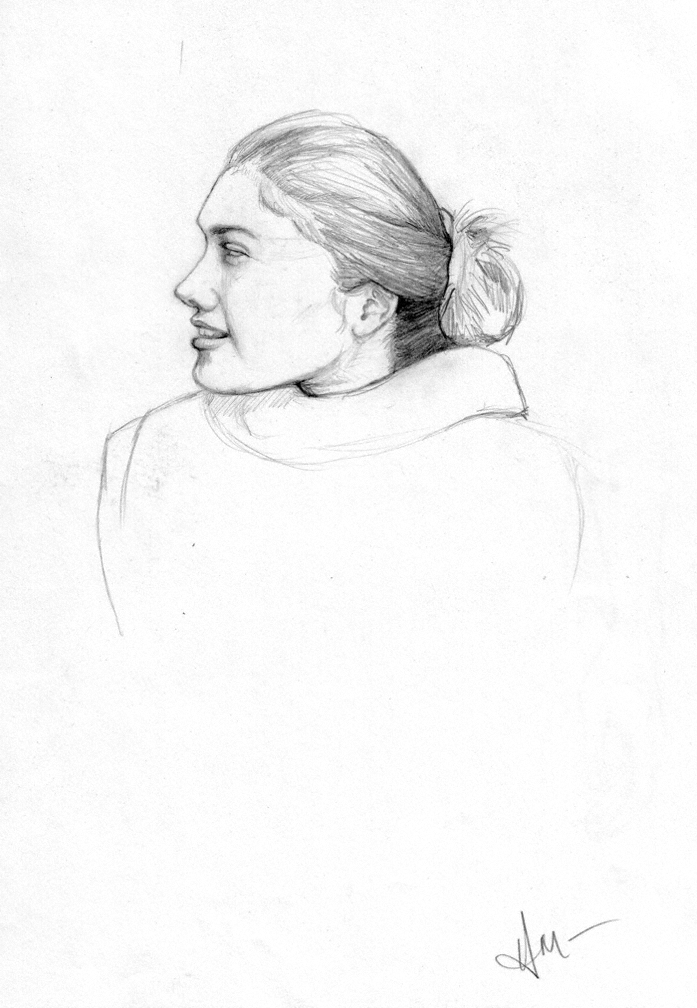
I mention that sketch by Salvador Dali because this drawing by Haley McCalister has some of that same quality of both softness and clarity that I admire so much in a well-rendered pencil drawing. Unfortunately, the scan of the sketch "hardened" the drawing. The original is even more appealing and demonstrates a fine balance of tone, line and contrast.